
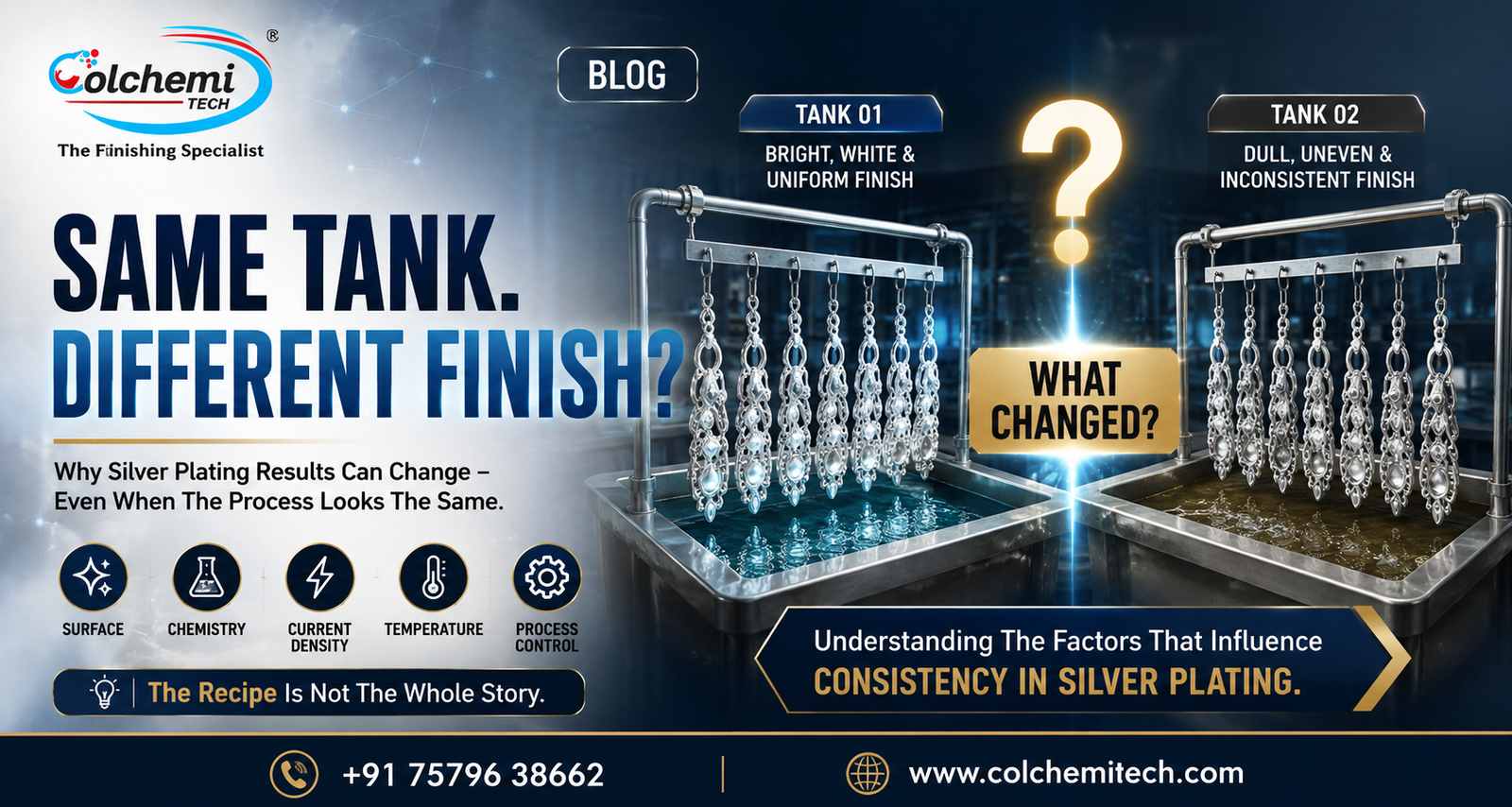
Same Jewellery. Same Silver. Similar Plating Process. So Why Can The Final Finish Look Completely Different?
This is one of the most important questions in silver electroplating.
Two manufacturers may use similar jewellery pieces, similar silver plating processes and even comparable equipment—but the final results can still vary significantly.
One batch may have a bright, clean and uniform appearance.
Another may show dullness, uneven reflection or differences in brightness.
So, is the problem always the silver plating chemical?
Not necessarily.
The final appearance of silver plating is influenced by several interconnected factors. Understanding these factors can help manufacturers move from simply achieving a good finish to achieving a consistent silver plating finish.
The Plating Recipe Is Only One Part Of The Process
A common assumption in electroplating is:
Same recipe = Same result.
But real-world plating is rarely that simple.
The final silver finish can be influenced by:
- Surface preparation
- Bath condition
- Silver plating chemistry
- Brightener concentration
- Current density
- Temperature
- Plating time
- Equipment condition
- Anode-to-cathode positioning
- Racking and contact
- Process control
This means that two tanks can follow a similar process and still produce different results.
1. Surface Preparation Can Change Everything
Before silver is deposited, the surface needs to be properly prepared.
Cleaning and preparation influence how the plating layer interacts with the substrate.
If one batch enters the plating bath with a properly prepared surface while another has variations in:
- Cleaning
- Activation
- Surface contamination
- Previous coating condition
- Base-metal preparation
the final appearance can be different—even when the plating bath itself has not changed.
The lesson?
A premium silver finish starts before the jewellery enters the silver plating bath.
2. Bath Condition Doesn’t Stay Exactly The Same
A plating bath is not a static environment.
As production continues, the bath can change due to factors such as:
- Chemical consumption
- Contamination
- Drag-in
- Evaporation
- Build-up of unwanted materials
- Changes in operating conditions
This is why silver plating bath maintenance is an important part of consistent production.
A bath that performed exceptionally well yesterday may not necessarily behave identically today if its operating condition has changed.
Consistency requires monitoring—not assumptions.
3. Current Density Can Change The Appearance
Current density is another important factor in silver electroplating.
Different areas of a jewellery component can experience different current distribution.
This can influence the way silver is deposited and ultimately affect:
Brightness → Reflection → Surface Appearance
This becomes particularly important when plating:
- Intricate jewellery
- Deep recesses
- Edges
- Complex geometries
- Decorative components
Therefore, achieving a good finish isn’t simply about supplying current.
It is about maintaining appropriate and controlled plating conditions.
4. Temperature Can Influence Process Behaviour
Temperature is another process variable that manufacturers need to monitor.
Even when the same chemistry is used, variations in operating temperature can influence the behaviour of the plating system.
Small process variations can become more noticeable when production volumes increase.
This is why professional electroplating process control is focused on maintaining stable operating conditions rather than relying on occasional adjustments.
5. Brightener Chemistry Matters
This is where silver plating brighteners become particularly relevant.
Brighteners are designed to influence the appearance and characteristics of the deposited silver under the appropriate plating conditions.
However, the brightener should not be considered independently from the rest of the process.
A brightener system works within a broader plating environment involving:
Bath Condition + Surface Preparation + Current Density + Temperature + Chemistry Management
The goal isn’t simply to make one piece extremely shiny.
The bigger challenge is achieving a desirable finish consistently across production batches.
Why One Tank Can Look Better Than Another
Imagine two plating tanks.
TANK A
✔ Proper surface preparation
✔ Stable bath condition
✔ Controlled current density
✔ Appropriate temperature
✔ Correct chemistry management
✔ Consistent process control
TANK B
✔ Similar basic recipe
❌ Different surface preparation
❌ Changing bath condition
❌ Variable current distribution
❌ Temperature fluctuations
❌ Inconsistent process monitoring
Both tanks may technically be doing silver electroplating.
But their final appearance can be completely different.
That’s why manufacturers should look beyond the basic recipe.
The Hidden Factor: Process Consistency
Getting one beautiful silver-plated jewellery piece is not necessarily difficult.
The real challenge is producing:
Piece 1 → Piece 2 → Piece 3 → Piece 100 → Piece 1,000
with a similar visual appearance.
For commercial jewellery manufacturers, this matters enormously.
A difference in finish can affect:
- Product appearance
- Quality perception
- Rework
- Rejection rates
- Production efficiency
- Customer satisfaction
This is why consistent silver plating is one of the most important goals for professional manufacturers.
Can Better Silver Plating Chemicals Solve Everything?
No.
And this is an important distinction.
High-quality silver plating chemicals can support the plating process, but chemistry alone cannot compensate for every process problem.
For example:
Poor surface preparation + excellent chemistry = still a process challenge.
Unstable bath + excellent chemistry = inconsistent results.
Poor current distribution + excellent chemistry = uneven deposition.
The best results come when the chemistry and the process are working together.
Where COLSILBER® Fits Into The Process
At Colchemi Tech, our focus is on silver finishing chemistry designed for demanding electroplating applications.
The COLSILBER® Brightener range is developed for applications where manufacturers are looking for high-quality silver finishes and controlled plating performance.
The range can be used across applications such as:
- Jewellery
- Electroforming
- Giftware
- Automotive components
- Hotel cutlery
- Aerospace
- Electronics
- Electrical components
For manufacturers, the objective is not simply “more shine.”
It is about working toward the desired combination of:
Brightness + Whiteness + Reflection + Surface Quality + Consistency
A Simple Way To Think About Silver Plating Quality
Think of your plating process as a system with five connected elements:
1. Surface
The foundation of the finish.
2. Chemistry
The chemical environment in which silver deposition takes place.
3. Current
Controls the electrochemical deposition conditions.
4. Temperature
Helps maintain stable process behaviour.
5. Control
Keeps the entire process repeatable.
Remove consistency from any one of these areas, and the final result can change.
So, Why Do Two Plating Tanks Give Different Results?
The answer is simple:
Because silver plating is a process—not just a recipe.
Two tanks can use similar chemistry but operate under different conditions.
And those differences can influence the final appearance.
The manufacturers who consistently achieve premium results are not only looking for a powerful silver brightener.
They are looking at the complete process.
Final Takeaway
A beautiful silver finish doesn’t come from one magic ingredient.
It comes from understanding how different variables work together.
Surface Preparation
↓
Bath Condition
↓
Plating Chemistry
↓
Current Density
↓
Temperature
↓
Process Control
↓
Consistent Silver Finish
At Colchemi Tech, we believe that better finishing begins with better process understanding.
Because when chemistry and process control work together, manufacturers can work toward brighter, cleaner and more consistent silver finishing results.
COLCHEMI TECH
The Finishing Specialist