A bright, clean and uniform silver finish is an important requirement in jewellery plating and decorative metal finishing. Whether you are plating jewellery components, decorative parts or industrial components, the quality of the final silver deposit can directly influence appearance, consistency and customer satisfaction.
But choosing a silver brightener should not be based only on how much shine a product promises.
A brightener that performs well in one plating setup may not deliver the same results in another. Factors such as the silver plating bath, base material, surface preparation, current density, temperature, chemical concentration and overall process control can all influence the final result.
That is why manufacturers should evaluate a silver plating brightener from a process-first perspective.
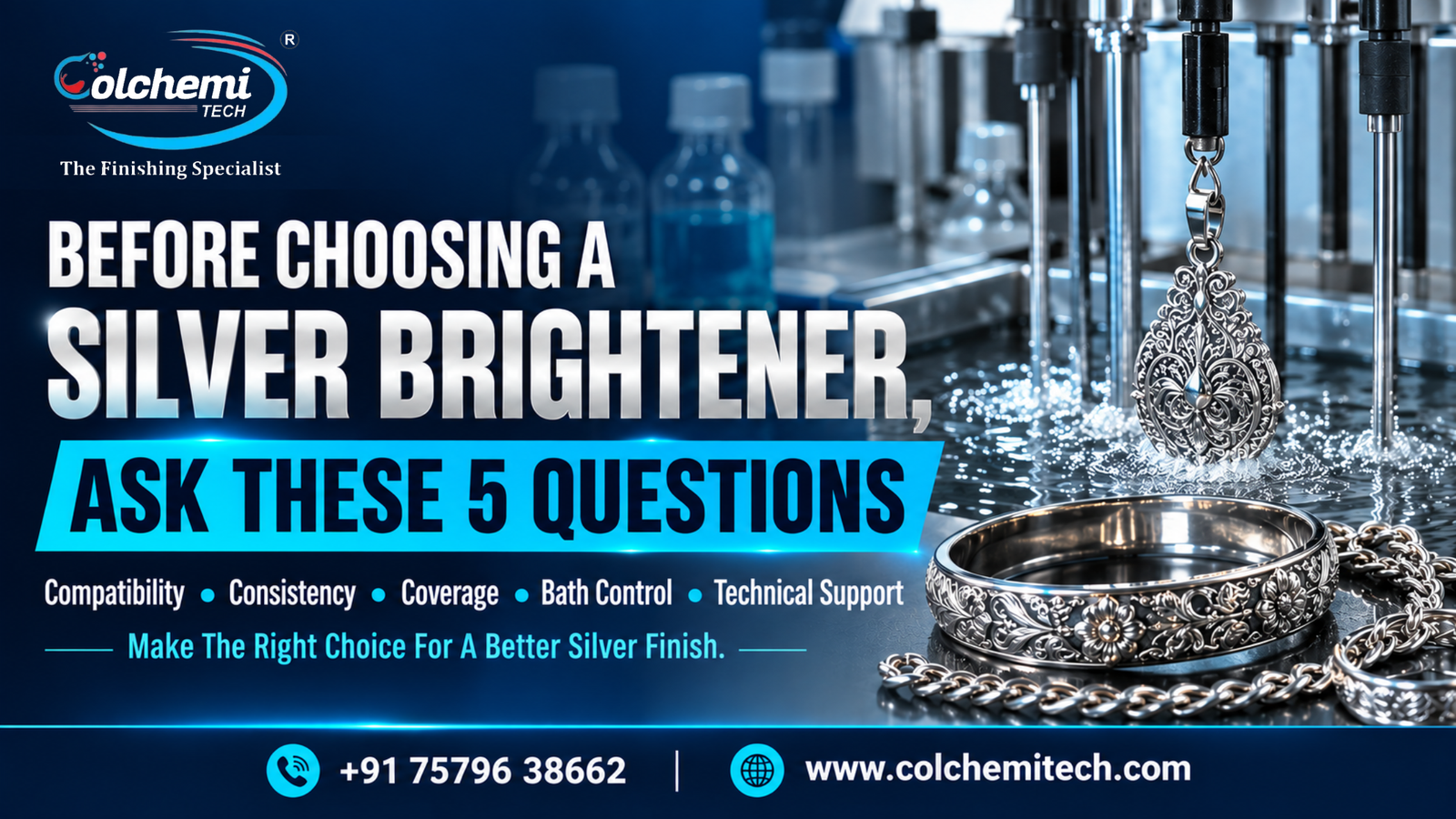
Before selecting a product for your plating line, here are five important questions you should ask.
1. Is The Silver Brightener Compatible With Your Plating Process?
Every silver electroplating process has its own requirements. The type of silver bath, base material, plating method and production conditions can all affect how a brightener performs.
A product designed for one silver plating system may not automatically be suitable for another chemical formulation.
Before selecting a silver brightener, check:
- Is it compatible with your existing silver plating bath?
- Is it suitable for your silver salt and other additives?
- Can it be used with your plating method?
- Is it suitable for jewellery or industrial applications?
- Does it work within your existing operating conditions?
For example, jewellery plating may require a different appearance and process approach compared with certain industrial silver plating applications.
The required characteristics can also vary depending on the application. Some manufacturers may prioritise brilliant appearance, while others may focus on uniform deposition, conductivity, wear resistance or overall process stability.
Key Takeaway
Choose a silver brightener according to your complete plating process—not simply according to its advertised brightness.
2. Does It Deliver Consistent Brightness And Uniform Coverage?
Getting one bright sample is not enough.
For commercial production, a silver plating brightener should help maintain a consistent finish across batches and different production cycles.
Manufacturers may face problems such as:
- One batch looks bright while another looks dull.
- Edges appear different from flat surfaces.
- Complex jewellery designs show uneven brightness.
- The finish changes during continuous production.
- Rejection and rework increase.
Several factors can contribute to these issues, including incorrect dosing, contamination, poor surface preparation, bath imbalance and unsuitable operating parameters.
A good silver plating brightener should be evaluated for its ability to support:
- Consistent silver brightness
- Uniform deposition
- Smooth surface appearance
- Good coverage on different shapes
- Stable performance during production
The brightest first sample is not always the best indicator of long-term performance.
Key Takeaway
The real test of a silver brightener is how consistently it performs—not how impressive the first sample looks.
3. Does It Perform Well On Different Jewellery Designs And Base Materials?
Jewellery manufacturers rarely work with only one type of product.
Rings, chains, earrings, pendants, bangles and intricate components can all behave differently during electroplating.
The final result can be influenced by:
- Product shape
- Surface area
- Sharp edges
- Recessed areas
- Polishing quality
- Base material
- Racking arrangement
- Barrel movement
- Current distribution
Silver plating may be carried out over suitable substrates such as copper, brass, nickel-plated surfaces and other compatible materials.
The condition of the underlying surface is particularly important. Poor cleaning, inadequate preparation or surface contamination can affect the final appearance and adhesion of the silver deposit.
Therefore, a brightener should ideally be evaluated using actual production components, rather than relying only on a simple flat test panel.
Ask:
- Does it provide a consistent finish on different jewellery designs?
- Does it work with your base material?
- Does it provide suitable brightness on complex shapes?
- Does it maintain a clean appearance in recessed areas?
- Does the finish remain consistent during production?
Key Takeaway
Always test a silver brightener on the actual products you manufacture before introducing it into regular production.
4. Is The Dosing And Bath Maintenance Easy To Control?
A silver brightener is a chemical additive, and its performance depends heavily on correct dosing and bath management.
Too little or too much brightener can affect the appearance and quality of the silver deposit. For this reason, manufacturers should understand exactly how the product is intended to be used.
Before selecting a brightener, ask the supplier about:
- Initial dosage
- Recommended replenishment
- Operating concentration
- Compatibility with other additives
- Bath testing requirements
- Storage and handling
- Signs of underdosing or overdosing
A well-defined dosing procedure can make production easier to monitor and maintain.
This becomes particularly important in continuous production, where small changes in bath chemistry can gradually influence the final finish.
A product may give excellent results during an initial trial, but if its maintenance requirements are difficult to understand or control, maintaining those results over time can become challenging.
Key Takeaway
Choose a brightener with clear dosing instructions and a practical approach to bath maintenance.
5. Does The Manufacturer Provide Technical Support?
Choosing the right silver plating chemicals is only one part of achieving consistent plating results.
Technical support from the chemical supplier can also make a significant difference, especially when introducing a new product into an existing plating line.
Manufacturers may encounter issues such as:
- Dull silver finish
- Uneven brightness
- Yellowish appearance
- Poor adhesion
- Excessive rejection
- Bath contamination
- Frequent chemical adjustments
- Variation between production batches
Before purchasing, ask your supplier:
- Do you provide application guidance?
- Can you recommend the product according to our plating process?
- Do you provide dosage guidance?
- Can you assist with bath maintenance?
- Do you provide troubleshooting support?
- Can you support production trials?
- Do you provide relevant product and safety documentation?
A supplier that understands the application can help manufacturers evaluate the product more effectively and troubleshoot process-related challenges.
Key Takeaway
A reliable chemical supplier should support your process—not simply supply the chemical.
What Should You Check Before Finalising A Silver Brightener?
Before making a purchase decision, compare a product across multiple factors instead of focusing only on price or initial brightness.
| Evaluation Factor | What You Should Check |
|---|---|
| Process Compatibility | Works with your existing silver plating bath |
| Brightness | Produces the required silver finish |
| Uniformity | Provides consistent coverage across different designs |
| Bath Stability | Supports stable performance during production |
| Dosing | Clear and manageable replenishment instructions |
| Application | Suitable for your plating method and product type |
| Technical Support | Assistance with trials, maintenance and troubleshooting |
| Production Value | Helps support consistent quality and reduce unnecessary rework |
Why Choosing The Right Silver Brightener Matters
Selecting the right silver brightener can help manufacturers work toward:
- Better surface appearance
- More consistent production quality
- Improved process control
- Reduced finishing-related rejection
- Lower rework requirements
- More predictable plating performance
- Better customer satisfaction
However, it is important to remember that a brightener is only one part of the overall plating process.
Surface preparation, cleaning, activation, bath chemistry, electrical parameters, temperature, plating time and post-treatment can all influence the final silver finish.
A Brightener Can Improve The Finish, But Process Consistency Creates The Quality.
Choose A Silver Brightener With A Process-First Approach
Before choosing a silver plating chemical, don’t ask only:
“How much shine will this product give?”
Instead, ask:
“Will this product help us achieve consistent, uniform and reliable silver plating results?”
This change in approach can help manufacturers make better decisions when evaluating silver electroplating chemicals for jewellery and industrial applications.
At Colchemi Tech, the focus is on practical silver finishing solutions designed around the requirements of modern plating applications.
COLSILBER® Brightener Part A & Part B
COLSILBER® Brightener Part A & Part B is a two-part silver brightener system developed to support a brilliant and clean silver finish when used with the appropriate plating process and recommended operating conditions.
The system is intended for applications where manufacturers are looking for controlled and consistent silver finishing performance.
For product suitability, dosage guidance and application support, contact the Colchemi Tech technical team before starting production trials.
Contact Colchemi Tech
Phone: +91 75796 38662
Website: www.colchemitech.com
Email: info@colchemitech.com