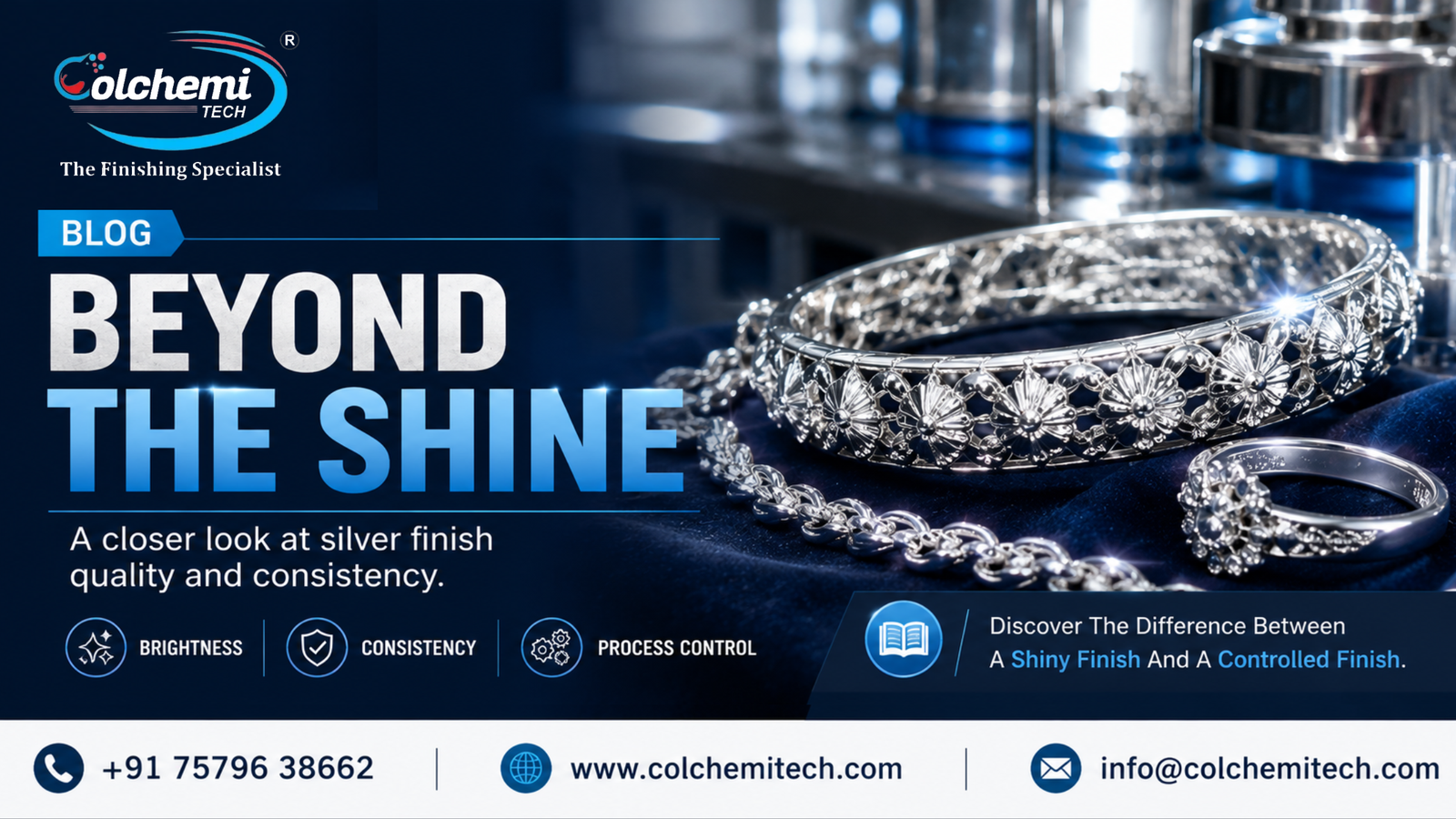
When it comes to silver plating, shine gets attention first.
A bright, reflective silver surface immediately looks attractive. For jewellery manufacturers and plating professionals, achieving that brilliant appearance is an important part of the finishing process.
But there is an important question that often gets overlooked:
Is a shiny silver finish always a sign of a well-controlled plating process?
Not necessarily.
A silver-plated article can look extremely bright after one successful batch, while the same process may produce a different result in the next batch.
This is where the difference between a shiny finish and a controlled finish becomes important.
A shiny finish tells you what the surface looks like.
A controlled finish tells you how reliably you can reproduce that result.
What Is A Shiny Silver Finish?
A shiny silver finish is primarily about appearance.
The surface may have:
- High brightness
- Strong reflectivity
- Clean visual appearance
- Smooth-looking surface
- Attractive white-silver colour
For decorative applications, especially jewellery, visual appearance is obviously important.
But appearance alone doesn’t tell the complete story.
If the same plating process gives a brilliant result today and a dull or uneven result tomorrow, the process may lack the consistency required for reliable production.
That is why manufacturers should look beyond the first impressive sample.
What Is A Controlled Silver Finish?
A controlled silver finish is about repeatability and process stability.
It means the plating process is managed in a way that helps manufacturers achieve a similar level of quality across batches.
This involves controlling several factors, such as:
Surface Preparation
↓
Cleaning & Activation
↓
Plating Bath Condition
↓
Chemical Balance
↓
Brightener Management
↓
Electrical Parameters
↓
Temperature & Process Conditions
↓
Final Finish
The goal is not simply:
“Can we make it bright?”
The better question is:
“Can we make it consistently bright?”
Why Brightness Alone Can Be Misleading
Imagine a manufacturer plates 20 jewellery pieces as a trial.
The result is excellent.
The pieces have a brilliant silver appearance, good reflectivity and a premium finish.
It would be easy to conclude that the plating process is perfect.
But now increase production.
The manufacturer plates hundreds or thousands of pieces.
Suddenly, some pieces appear slightly duller. Some areas have different brightness. The next batch does not look exactly like the previous one.
This is where the real challenge begins.
A successful sample proves that the process can work.
Consistent production proves that the process is under control.
That distinction is extremely important in commercial silver electroplating.
What Creates A Controlled Silver Plating Process?
1. Proper Surface Preparation
Silver plating does not begin when the article enters the silver plating bath.
It begins much earlier.
Cleaning and surface preparation influence how effectively the subsequent plating layers can form on the surface.
Oil, grease, polishing residues, oxides or other contaminants can interfere with the plating process.
Therefore, even a good silver plating chemical cannot compensate for poor surface preparation.
Better preparation creates a better foundation for consistent plating.
2. Stable Plating Bath Chemistry
The plating bath is a working chemical system.
Its condition can change during production because of:
- Chemical consumption
- Drag-out
- Contamination
- Additive depletion
- Incorrect replenishment
- Changes in operating conditions
If bath chemistry is not properly maintained, the appearance of the silver deposit can gradually change.
This is why bath monitoring and appropriate chemical replenishment are important parts of production control.
3. Correct Brightener Management
A silver brightener can play an important role in achieving the required appearance and finish.
But adding more brightener does not automatically mean getting more brightness.
Incorrect dosing can disturb the intended balance of the plating system.
A professional approach is to follow the supplier’s recommended dosage and operating conditions and monitor the bath rather than making uncontrolled adjustments.
For two-part systems such as Part A and Part B silver brighteners, understanding the role and recommended balance of each component is particularly important.
The objective is not maximum chemical addition.
The objective is controlled performance.
4. Consistent Electrical Parameters
Current density, voltage, plating time and other electrical conditions influence how the silver deposit develops.
Different jewellery designs can also distribute current differently.
For example, sharp edges, recessed areas and complex shapes may behave differently from flat surfaces.
This means that even when the chemistry remains the same, changes in electrical or process conditions can influence the final appearance.
Good chemistry needs good process control around it.
5. Bath Maintenance During Continuous Production
One of the biggest differences between a laboratory trial and commercial production is time.
A plating bath may perform very well initially.
But continuous production introduces:
More Articles → More Chemical Consumption → More Drag-Out → More Contamination Risk → Changing Bath Condition
If these factors are not monitored, performance can gradually shift.
That is why manufacturers should not evaluate a silver plating solution only on its initial performance.
They should also consider:
How does it perform after continuous production?
Shiny vs Controlled: What’s The Difference?
| Shiny Silver Finish | Controlled Silver Finish |
|---|---|
| Focuses mainly on appearance | Focuses on appearance + repeatability |
| Can be impressive in a sample | Designed for consistent production |
| May look excellent initially | Aims for stable performance |
| Brightness is the main observation | Brightness, uniformity and process stability matter |
| Does not explain the process | Reflects better process control |
| Short-term result | Long-term production approach |
The difference is simple:
Shine is the result you see. Control is what helps you reproduce it.
Why This Matters For Jewellery Manufacturers
In jewellery manufacturing, consistency is critical.
Customers don’t expect one piece to look brilliant while another piece from the same collection looks noticeably different.
Inconsistent silver plating can lead to:
- Rework
- Production delays
- Increased chemical consumption
- Batch rejection
- Customer complaints
- Additional labour
- Difficulty maintaining quality standards
Therefore, the value of a silver plating process should not be measured only by how bright the first batch looks.
It should also be evaluated by how consistently that quality can be maintained.
Don’t Blame The Brightener Too Quickly
When silver plating starts producing a different finish, the first reaction is often:
“The chemical isn’t working.”
But before replacing the product, it is worth checking the complete process.
Ask:
Is the surface properly prepared?
Is the bath condition within the recommended range?
Is the brightener being replenished correctly?
Has contamination increased?
Have electrical parameters changed?
Is the temperature consistent?
Are different jewellery designs behaving differently?
Only after understanding these factors can the actual cause be identified more effectively.
A process problem should not automatically become a chemical replacement problem.
The Right Silver Plating Chemical Is Only One Part Of The Equation
Choosing a suitable silver electroplating chemical is important, but it is only one part of achieving reliable finishing results.
A better approach combines:
Right Chemistry
+
Proper Surface Preparation
+
Controlled Parameters
+
Bath Maintenance
+
Correct Chemical Management
+
Technical Understanding
This combination creates the foundation for a more consistent silver plating process.
What Should Manufacturers Look For In A Silver Brightener?
Before selecting a silver plating brightener, consider more than just the brightness of the test sample.
Look at:
1. Compatibility
Is the brightener suitable for your plating system and application?
2. Consistency
Can it support repeatable results during production?
3. Uniformity
Does it provide the required finish across different designs?
4. Bath Management
Are dosing and replenishment requirements clearly defined?
5. Technical Support
Can the supplier help with application, trials and troubleshooting?
These questions can help manufacturers make a more informed decision.
The Real Meaning Of A Premium Silver Finish
A premium silver finish is not simply the brightest finish you can produce.
It is a finish that combines:
Brightness
Uniformity
Consistency
Process Stability
Repeatability
That is the difference between making something shine and building a reliable finishing process.
How Colchemi Tech Approaches Silver Finishing
At Colchemi Tech, the focus is not only on achieving an attractive silver appearance but also on understanding the process behind consistent finishing.
Our approach is centred around the relationship between silver plating chemistry, process control and production requirements.
For manufacturers evaluating silver plating chemicals or silver brightener systems, understanding the application and process requirements is an important first step.
Because Better Finishing Is Not Just About More Shine.
It Is About More Control Behind The Shine.
Final Takeaway
A brilliant silver finish may impress you on the first inspection.
But a controlled silver finish is what gives manufacturers confidence during continuous production.
The goal should not simply be to achieve a beautiful silver finish once.
The real goal is to develop a process capable of delivering beautiful, consistent and repeatable results—batch after batch.
Don’t Just Chase Shine. Build The Process Behind It.
Colchemi Tech – The Finishing Specialist
📞 +91 75796 38662
🌐 www.colchemitech.com
✉️ info@colchemitech.com