
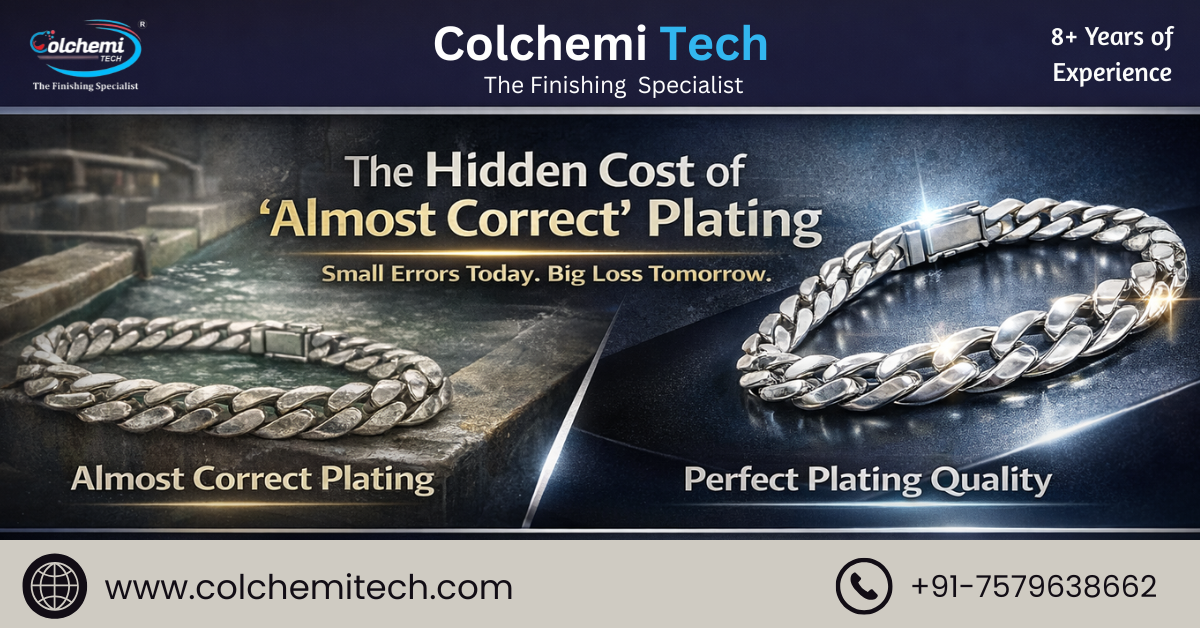
In many jewellery manufacturing units, plating is often considered acceptable if it looks “good enough.”
The surface appears bright.
The product passes visual inspection.
Production continues without interruption.
But in reality, “almost correct” plating is one of the biggest hidden risks in electroplating.
Why “Good Enough” Is Not Enough in Plating
Electroplating is not just about appearance.
It is a precision-driven chemical process where even small deviations can lead to major issues.
A surface may look perfect today,
but if the process is not fully controlled,
the quality may not last.
This is where most plating units face problems —
they focus on short-term results instead of long-term consistency.
Common Signs of “Almost Correct” Plating
Many manufacturers unknowingly operate under slightly incorrect conditions.
Some common indicators include:
• Minor variation in brightness between batches
• Slight color inconsistency
• Occasional rejection without clear reason
• Increased chemical consumption over time
These may seem like small issues,
but they are clear signs of plating process instability.
The Real Causes Behind Plating Problems
“Almost correct” plating is usually the result of multiple small gaps in the process:
1️⃣ Chemical Imbalance
Improper control of bath chemistry can lead to inconsistent results and plating defects.
2️⃣ Incorrect Brightener Dosage
Overuse or underuse of brightener directly impacts surface finish and durability.
3️⃣ Poor Surface Preparation
If cleaning and activation are not properly done, adhesion problems can occur.
4️⃣ Lack of Process Control
Without monitoring parameters like temperature, pH, and current density, consistency cannot be maintained.
The Hidden Costs You Cannot Ignore
Ignoring these small issues leads to major business impact:
🔹 Rejection & Rework
Defective products require replating, increasing time and cost.
🔹 Increased Chemical Consumption
Trying to fix problems often results in overdosing, leading to wastage.
🔹 Production Inefficiency
Frequent adjustments slow down operations and reduce productivity.
🔹 Loss of Customer Trust
Inconsistent quality can affect long-term business relationships.
Why Process Control Is the Key
The difference between average and high-quality plating is not the equipment —
it is the level of control.
A well-controlled plating process ensures:
✔ Stable bath chemistry
✔ Consistent brightener performance
✔ Uniform coating quality
✔ Reduced rejection rate
In simple terms,
better control = better results + lower cost.
Moving from “Almost Correct” to “Perfectly Controlled”
To improve plating quality, manufacturers should focus on:
• Regular bath analysis
• Controlled chemical addition
• Proper filtration and cleaning
• Standardized operating procedures
• Continuous process monitoring
These steps help in achieving consistent and repeatable plating results.
💡 Final Thought
In electroplating,
the gap between “almost correct” and “fully correct” is not small.
It directly affects:
👉 Product quality
👉 Production cost
👉 Business growth
A plating process that is slightly off today
can become a major problem tomorrow.
🔷 About Col Chemi Tech
At Col Chemi Tech, we believe that plating is not just about achieving brightness —
it is about delivering consistent, reliable, and high-performance results.
Our solutions are designed to support manufacturers in maintaining
stable plating processes, controlled chemical usage, and long-term quality improvement.